

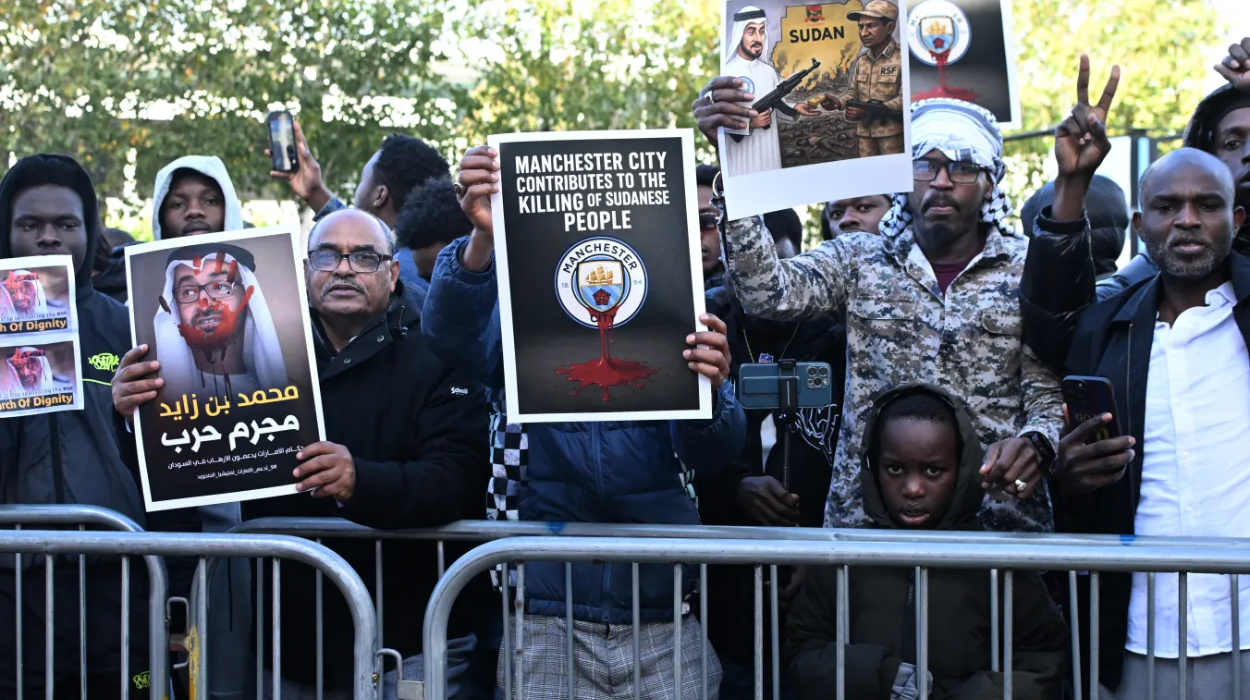
On a brisk afternoon in Manchester, the iconic Etihad Stadium became more than just a football venue—it turned into a site of protest and political expression. A growing number of Sudanese activists gathered outside the stadium to demand accountability from Manchester City’s ownership group, citing alleged links between the club’s parent entities and controversial political dealings affecting Sudan’s ongoing humanitarian crisis.
The demonstration highlighted how global football ownership structures are increasingly intersecting with issues of ethics, human rights, and public responsibility. As Manchester City continues to dominate on the pitch, the club’s off-field associations are facing mounting scrutiny from human-rights advocates.
The Root of the Protest
Human Rights and Football’s Global Reach
Football has always been more than a sport—it’s a multi-billion-pound global enterprise intertwined with power, politics, and prestige. The rally at the Etihad wasn’t simply an opposition to Manchester City as a team, but rather a statement about how ownership and governance in football reflect broader moral responsibilities in global affairs.
The protesters, composed largely of Sudanese expatriates and human rights advocates, demanded transparency regarding alleged financial and political ties between members of Manchester City’s parent organization, City Football Group (CFG), and individuals or institutions accused of contributing to Sudan’s current humanitarian crisis.
They carried banners calling for “accountability in football ownership” and chanted slogans linking the profits of powerful football ownership networks to the suffering of civilians in conflict zones.
Background: The Sudan Conflict Connection
Why Sudanese Voices Are Rising
Sudan’s recent history is defined by political instability, economic collapse, and widespread violence following the derailment of democratic transitions. According to rights organizations, parts of Sudan have seen severe humanitarian abuses, mass displacement, and restrictions on basic freedoms.
Sudanese diaspora communities in the UK have played a crucial role in amplifying awareness about these issues. Many see Manchester City’s global platform as a powerful opportunity to bring these injustices to light, especially given the football club’s ties to elite business and political networks across the Middle East.
Activists at the Etihad pointed to a concerning overlap between football investment, state wealth funds, and regions where governance abuses persist. Their demand was simple yet pointed: if football club owners benefit from global influence, they must also bear moral accountability for where that influence stems from.
Manchester City’s Ownership and Alleged Links
Understanding City Football Group’s Structure
Manchester City is owned by City Football Group, a global holding company primarily backed by the Abu Dhabi United Group, with additional investment from American and Chinese firms. The Abu Dhabi United Group, founded by Sheikh Mansour bin Zayed Al Nahyan—who also serves as the Vice President of the UAE—has faced ongoing criticism from rights activists regarding governance, transparency, and alleged suppression of dissent.
While there is no direct link between Manchester City’s daily operations and Sudan’s conflict, activists argue that the symbolic economic power of Gulf investment portfolios can indirectly sustain political interests tied to regional conflicts, including in Sudan.
Their argument reflects a growing global concern about how elite capital movement—especially through sports ownership—can serve as a soft power tool to reshape public narratives about human rights records.
The Protest at Etihad: Voices of Conscience
A Peaceful but Impactful Demonstration
Eyewitness accounts describe a peaceful but emotionally charged demonstration. Sudanese flags were draped across railings, and signs bore messages such as “Football Should Stand for Freedom” and “No Goals Without Justice.”
Participants called for Manchester City’s leadership to engage in dialogue, use their influence to push discussions about Sudan’s humanitarian crisis, and uphold ethical transparency in global partnerships.
Several speakers emphasized that the protest was not anti-football—rather, it was aimed at ensuring football does not become a vehicle for political image-washing or moral disengagement.
Quotes From the Protest
One activist stated, “We love football. That’s why we’re here. But you can’t celebrate success built on silence when millions are suffering in Sudan.”
Another protester emphasized the international stage that Premier League clubs occupy:
“Manchester City has the world’s attention every weekend. That influence comes with responsibility.”
These sentiments echoed across social media as videos from the march spread quickly, turning a local demonstration into a topic of international conversation.
Global Reactions and Media Response
Fans and Commentators Weigh In
The event sparked mixed reactions among fans. Some supporters voiced sympathy for the activists, acknowledging that ethical ownership matters for football’s future integrity. Others expressed frustration, arguing that the protest unfairly targeted the club without clear evidence of direct involvement in Sudan’s situation.
Media outlets across Europe and the Middle East picked up the story, framing it within the broader debate about sportswashing—the practice of using sports investments to improve a nation’s or entity’s public image despite questionable political or human rights records.
Even within the football community, figures such as journalists and analysts called for transparency, urging organizations like FIFA and UEFA to strengthen due diligence standards for club ownership.
The Broader Question: Ethics in Football Ownership
Sportswashing and Responsibility
The Etihad protest sits within a long-running global debate: should football ownership be subject to ethical oversight? Critics argue that foreign investments in football clubs can serve as instruments to soften political reputations or distract from governance issues.
Examples abound—from the scrutiny over Newcastle United’s Saudi-backed ownership to questions about Qatar’s role in the 2022 World Cup. The Sudanese activists’ rally is part of a larger movement urging accountability mechanisms for entities that control not just clubs, but public sentiment through sport.
Proponents of greater accountability call for:
- Transparency in financial sources behind club acquisitions.
- Human rights impact assessments for state-linked ownership.
- Public reporting standards for large football consortiums.
- Independent oversight bodies within international football institutions.
What Comes Next
The Continuing Role of Activism
For the protesters, the rally at Etihad was only the beginning. Campaign organizers announced upcoming petitions and open letters to the Premier League and City Football Group executives. They aim to spark dialogue around how wealthy investors and state affiliates engage with global sport.
Their goal is not to dismantle successful clubs, but to encourage ethical responsibility that matches football’s cultural influence. Whether Manchester City’s management issues a response remains to be seen, but the demonstration has ensured that discussions around Sudan’s conflict—and football’s moral obligations—will not fade quietly.
Football As a Platform for Change
The Etihad protest exemplifies a growing reality: football fans care not only about trophies but about values. Stadiums, broadcasts, and global fanbases can act as powerful platforms for social responsibility. As more supporters demand transparency from those who own the clubs they love, football may be forced to redefine what success looks like—not only in goals scored, but in moral leadership displayed.
Closing Thoughts
The Sudanese activists rally at the Etihad represents a historic crossover of sports, politics, and ethics. It reveals a shifting cultural understanding that global football clubs, often symbols of unity and identity, cannot remain detached from the realities their ownership structures may represent.
For Manchester City and other major clubs, the challenge will be to balance triumph on the field with accountability off it—because in today’s interconnected world, the true measure of a team’s greatness may extend far beyond the pitch.
