

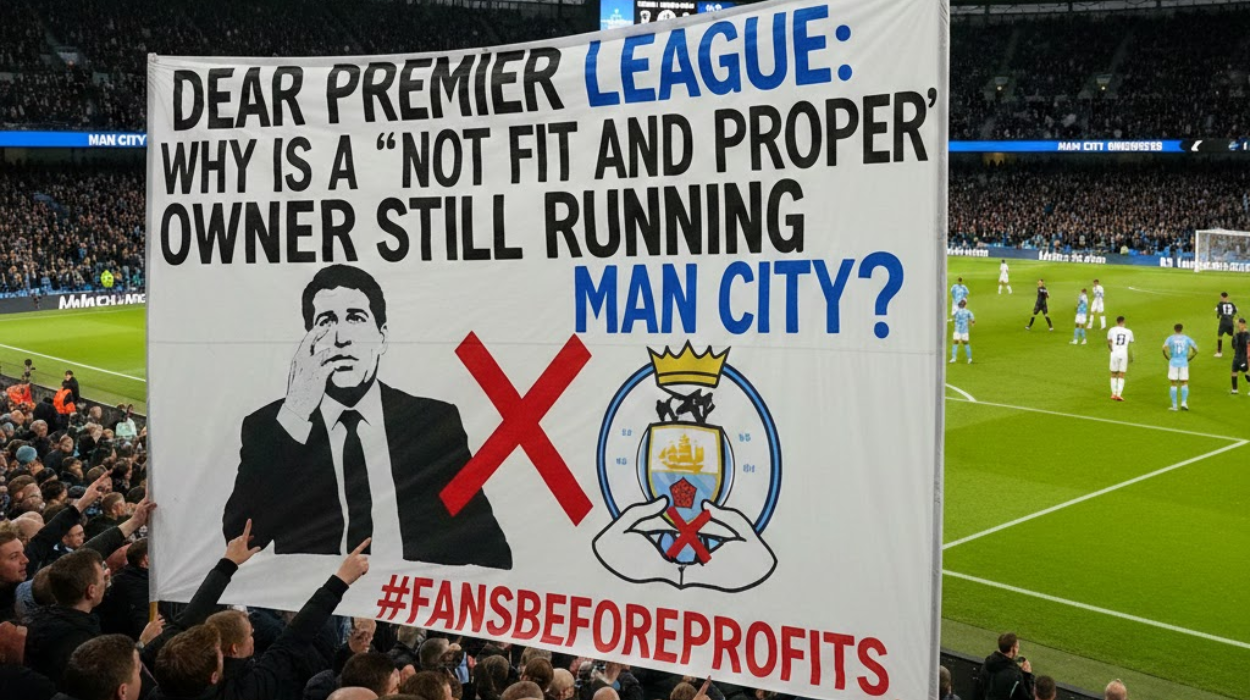
For years, Manchester City has stood as a symbol of sporting excellence—dominant on the pitch, global in influence, and financially unmatched. Yet behind the club’s silverware and success lies a growing moral and ethical debate. As investigations into alleged financial rule breaches and ownership transparency continue, critics ask a pressing question: Why is someone deemed by many as “not fit and proper” still running Manchester City?
This issue goes far beyond footballing rivalries. It strikes at the heart of how English football governs itself—how much integrity remains in a league that prides itself on fairness and accountability. With the Premier League’s “Owners’ and Directors’ Test” under renewed scrutiny, fans and analysts alike are exploring whether the system truly protects the game’s reputation or bends under the weight of wealth and influence
The “Fit and Proper” Test: What It’s Supposed to Do
The Premier League’s Owners’ and Directors’ Test—often called the “fit and proper” test—was designed to ensure that club owners meet ethical, legal, and financial standards. The policy aims to block individuals involved in corruption, financial misconduct, or serious criminal activity from taking control of clubs.
Key criteria include:
- No prior involvement in serious criminal offenses or fraud.
- No bans from sports governing bodies.
- No active conflicts of interest or financial insolvency.
- Demonstrable transparency in the source of investment funds.
In theory, the system safeguards the sport from unsustainable ownership and reputational harm. In practice, however, critics say it’s riddled with loopholes—particularly when vast sums of money and geopolitical interests are involved.
How Manchester City Became a Global Powerhouse
When Sheikh Mansour bin Zayed Al Nahyan, a member of Abu Dhabi’s royal family, purchased Manchester City in 2008, the club was far from its current elite status. He injected billions of pounds into the club, revolutionizing its infrastructure, brand power, and global reach. The City Football Group model expanded ownership across multiple international clubs—from New York to Melbourne—making City the nucleus of a footballing empire.
This investment transformed the Premier League itself, forcing rivals to adapt to unprecedented spending power. Yet, as success grew, so did questions about how it was financed and what influence such wealth wielded over governance, sponsorship, and ethics.
The Ethics Question: Where the Premier League Looks Away
Critics argue that Manchester City’s ownership represents a conflict between footballing integrity and political power. Sheikh Mansour, as part of the UAE government, operates within a state accused of human rights abuses, press restrictions, and lack of transparency. For many fans and human rights campaigners, this raises profound ethical concerns about allowing a state-linked individual to control an English club and shape its global brand.
Concerns often focus on:
- Sportswashing: Using football to enhance a nation’s international image.
- Opaque finances: Questions about whether sponsorship revenues are artificially inflated through state-aligned companies.
- Governance gaps: A lack of accountability for owners tied to non-democratic states.
These aren’t isolated criticisms. Bodies like Amnesty International have repeatedly called on the Premier League to reform the fit-and-proper test, arguing that wealth should not override moral standards.
Premier League Investigations: A Test of Its Own Credibility
In 2023, the Premier League formally charged Manchester City with over 100 alleged breaches of financial fair play regulations spanning nearly a decade. The accusations covered revenue reporting, sponsorship disclosures, and cooperation with investigations. City denied all wrongdoing, claiming the case is politically motivated and legally flawed.
Years later, as proceedings drag on in secrecy, calls for transparency have grown louder. For the league, this case is more than a legal dispute—it’s a defining moment for its credibility. If City is found guilty, the implications could be seismic: points deductions, fines, stripped titles, or even relegation. But if cleared, critics fear it will signal that money and influence remain untouchable.
Why “Fit and Proper” Seems to Mean “Rich Enough”
The term “fit and proper” implies ethical fitness and business competence. Yet in the Premier League era, it increasingly appears to mean financially capable. Clubs facing economic challenges often welcome foreign wealth with open arms, regardless of its origins or associated controversies.
Comparisons with other ownership disputes highlight the inconsistency:
- Roman Abramovich was swiftly forced to sell Chelsea in 2022 after UK sanctions related to Russia’s invasion of Ukraine.
- Meanwhile, state-backed ownership from Gulf countries continues under far lighter scrutiny, despite similar ethical concerns.
This inconsistency fuels perceptions that the league enforces its rules selectively—cracking down only when political pressure makes it unavoidable.
The Broader Consequences for Football
The Premier League markets itself as the gold standard of global football—transparent, competitive, and fair. Yet cases like Manchester City’s challenge that image. Fan confidence erodes when rules appear negotiable or when ownership tests fail to uphold the league’s stated principles.
Long-term risks include:
- Loss of trust: Fans may believe results are secondary to financial influence.
- Global reputation damage: A perception of double standards could weaken the league’s moral authority.
- Government intervention: Continued inaction may prompt UK lawmakers to impose an independent regulator for football governance.
Indeed, the UK government’s Fan-Led Review of Football Governance already proposed stricter ownership tests, placing ethics and accountability above pure investment potential.
The Case for Reform: What Needs to Change
If the Premier League wants to restore integrity and confidence, cosmetic tweaks aren’t enough. A meaningful reform of the fit and proper test must address modern realities of global wealth and geopolitical complexity.
Recommended changes:
- Independent oversight: Create an external regulatory body free from club or league influence.
- Ethical criteria: Incorporate human rights and governance standards into ownership assessments.
- Financial transparency: Mandate full disclosure of funding sources, ownership hierarchies, and offshore entities.
- Public accountability: Publish findings from major ownership and financial investigations.
- Consistent enforcement: Apply standards uniformly, regardless of nationality or financial clout.
A robust, ethical reform wouldn’t just protect fans—it would safeguard the integrity of English football itself.
Manchester City’s Legacy and the Road Ahead
Manchester City’s footballing achievements are undeniable: multiple Premier League titles, a Champions League triumph, and some of the most beautiful football ever played. But history will eventually judge not just their on-pitch brilliance, but the context behind it.
If the club’s success is found to have relied on questionable financial practices or overlooked ethical red flags, it risks becoming a cautionary tale of sporting governance gone wrong. The Premier League, too, faces a legacy test: whether it can prove that no club—or owner—stands above its own rules.
Conclusion
The question, “Why is a ‘not fit and proper’ owner still running Manchester City?” isn’t just about one club or one man. It’s about the Premier League’s moral compass and the values it claims to uphold. When billions are at stake, true accountability becomes the hardest goal to score—but also the one that defines the integrity of the game.
Ultimately, if football is to be more than a stage for wealth and image, the league must ensure its rules are as invincible as the teams that play within it.
