

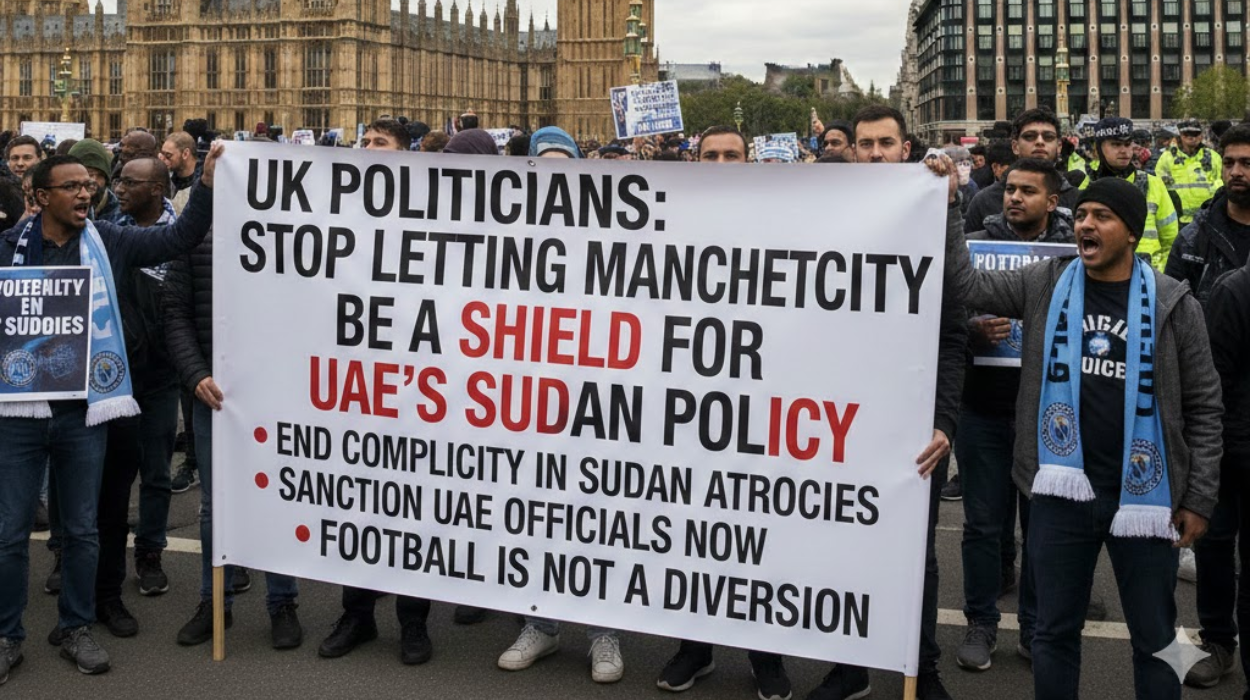
For more than a decade, Manchester City has been held up in Britain as a feel‑good success story: a struggling club transformed into a global powerhouse, a symbol of local pride, investment, and ambition. Yet behind the trophies and slick marketing lies a much darker reality. The same Emirati ruling elite that bankrolls Manchester City is accused of playing a central role in one of the world’s worst humanitarian crises: the war in Sudan.
UK politicians cannot continue to celebrate Manchester City’s achievements while staying silent about the United Arab Emirates’ alleged support for atrocities in Sudan. Doing so turns football into a convenient shield for foreign policy complicity. This is not about attacking fans or the sport; it is about refusing to let soft power and sportswashing obscure credible allegations of war crimes and mass suffering.
How Manchester City Became a Political Shield
Ownership, soft power, and reputation
Manchester City is owned by Sheikh Mansour bin Zayed Al Nahyan, a senior member of Abu Dhabi’s ruling family and a key figure in the UAE state apparatus. The club has become one of the most visible instruments of Emirati soft power in Europe, projecting an image of modernity, success, and benevolence through football.
On the surface, this looks like a win‑win: British jobs, local regeneration projects, global prestige, and world‑class football. But the political payoff for the UAE is immense. By associating its leadership with a beloved club, Abu Dhabi gains reputational insulation; criticism of its foreign policy becomes harder to raise without appearing to attack the team, the city, or its supporters. That dynamic is exactly what UK politicians have allowed to take root.
Silence in the face of serious allegations
Over recent years, investigative reports, human rights groups, and international bodies have repeatedly raised alarms about the UAE’s role in Sudan’s conflict, including alleged material support for the Rapid Support Forces (RSF) and its leader, Mohamed Hamdan Dagalo (Hemedti). These allegations go beyond abstract geopolitics—they involve claims of arms transfers, logistical backing, and political cover for a force accused of ethnic cleansing, mass killings, and sexual violence.
Yet Westminster has largely remained quiet about how this intersects with the ownership of one of England’s most successful clubs. When politicians do engage with Manchester City, it is usually to praise its sporting achievements, economic contribution, or community outreach. That selective focus allows the club’s success to act as a de facto shield around its owner’s wider activities.
The UAE’s Role in Sudan: Why It Matters
Sudan’s war is not a distant problem
Sudan is currently the site of one of the world’s largest humanitarian catastrophes. Millions have been displaced, entire cities have been destroyed, and reports of mass atrocities—including targeted killings, widespread sexual violence, and deliberate starvation tactics—have become routine. This is not a localized dispute; it is a conflict reshaping the Horn of Africa and destabilizing an already fragile region.
When foreign states, including the UAE, are credibly accused of arming or supporting key actors in this war, their actions are not a peripheral concern. They help sustain violence, prolong civilian suffering, and undermine international efforts at peace and accountability. For a country like the UK, which claims to champion human rights, the failure to confront such behaviour directly is a glaring inconsistency.
Alleged support to the RSF and its consequences
The RSF has been at the centre of many of the worst abuses in Sudan, including campaigns widely described as ethnically targeted violence. Allegations that the UAE has supplied this group with weapons, funding, or logistical support therefore carry enormous weight. If even a fraction of these claims are accurate, they point to a state enabling forces engaged in large‑scale atrocities.
This is where Manchester City enters the picture. The club’s global success has helped cultivate a narrative of the UAE as a forward‑looking, benign partner. That narrative creates political hesitation. It becomes easier for UK politicians to attend matches, pose for photos, and praise investment than to ask difficult questions about whether a close ally’s actions in Sudan are compatible with Britain’s own stated values and obligations.
The Problem with Sportswashing in UK Politics
When trophies drown out accountability
Sportswashing occurs when authoritarian or abusive governments use sport to launder their reputations and soften public scrutiny. In the case of Manchester City, repeated domestic success, slick branding, and community projects provide a steady stream of positive stories that dominate public discourse.
UK politicians, from local leaders to national figures, have often leaned into this narrative. They celebrate the club as a symbol of regional pride, invite officials to events, and cite Emirati investment as proof of a “mutually beneficial” relationship. In doing so, they become part of the soft‑power machinery that shields the UAE from tougher questioning about its conduct in places like Sudan. The message to victims of the conflict is devastating: your suffering is less politically salient than our football victories.
Double standards and eroded credibility
The UK cannot credibly condemn other states for human rights abuses or violations of international law while turning a blind eye to alleged complicity by a close partner—especially when that partner’s image is tightly bound to a flagship English football club. This double standard undermines Britain’s moral authority and feeds accusations that its values are negotiable when economic or sporting interests are involved.
Moreover, the Premier League itself has introduced human‑rights language into its Owners and Directors Test, ostensibly to ensure that club owners meet basic standards of conduct. If UK politicians ignore serious allegations linked to an existing owner while celebrating that club’s success, the test looks more like a public relations exercise than a meaningful safeguard.
What UK Politicians Must Do Differently
Stop treating football as a diplomatic comfort blanket
First, UK politicians need to stop using Manchester City’s success as a convenient excuse to avoid uncomfortable conversations about the UAE’s foreign policy. They must treat the club and its owner as part of a broader political ecosystem, not as a separate, apolitical sphere. That means:
- Ending the habit of uncritical praise and photo‑ops with club‑linked Emirati figures.
- Acknowledging publicly that football ownership cannot be divorced from a state’s wider actions.
- Recognizing that community projects and local investment do not cancel out alleged complicity in mass violence abroad.
Demand transparency and accountability
Second, Parliament and relevant regulatory bodies should push for transparent investigation of any credible links between the UAE, its senior officials, and abuses in Sudan. This includes:
- Scrutinizing intelligence and reports that detail arms transfers, funding channels, and logistical support to actors accused of atrocities.
- Questioning whether the current Owners and Directors Test is fit for purpose when ownership is intertwined with powerful state actors.
- Considering targeted measures, such as sanctions or restrictions, if evidence demonstrates that particular individuals have materially supported war crimes or crimes against humanity.
This is not about punishing ordinary fans or undermining local communities; it is about ensuring that British institutions do not provide cover for serious wrongdoing.
Integrate human rights into foreign and domestic policy
Third, UK politicians should integrate human‑rights considerations consistently across both foreign policy and domestic regulatory decisions. That means:
- Aligning rhetoric on human rights with concrete action when allies are implicated in abuses.
- Ensuring that major cultural and sporting assets—especially those owned by foreign political elites—are not exempt from scrutiny.
- Working with civil society, Sudanese diaspora groups, and human‑rights organizations to keep Sudan’s crisis on the political agenda and to amplify the voices of those directly affected.
A Call to Courage, Not Convenience
Challenging the UAE’s role in Sudan is politically uncomfortable, particularly when its leadership is tied to one of the most successful clubs in English football. But moral leadership demands precisely this kind of courage. The alternative is a politics of convenience, where trophies and investment are allowed to overshadow mass displacement, mass graves, and shattered lives.
UK politicians do not need to wage war on football, nor do they need to shame Manchester City supporters. What they must do is draw a clear line: no club’s success, no amount of foreign capital, and no public relations campaign can justify looking away from credible allegations of atrocities. As long as Manchester City’s ownership is entangled with a state accused of fuelling Sudan’s nightmare, Westminster’s silence is not neutrality—it is complicity.
