

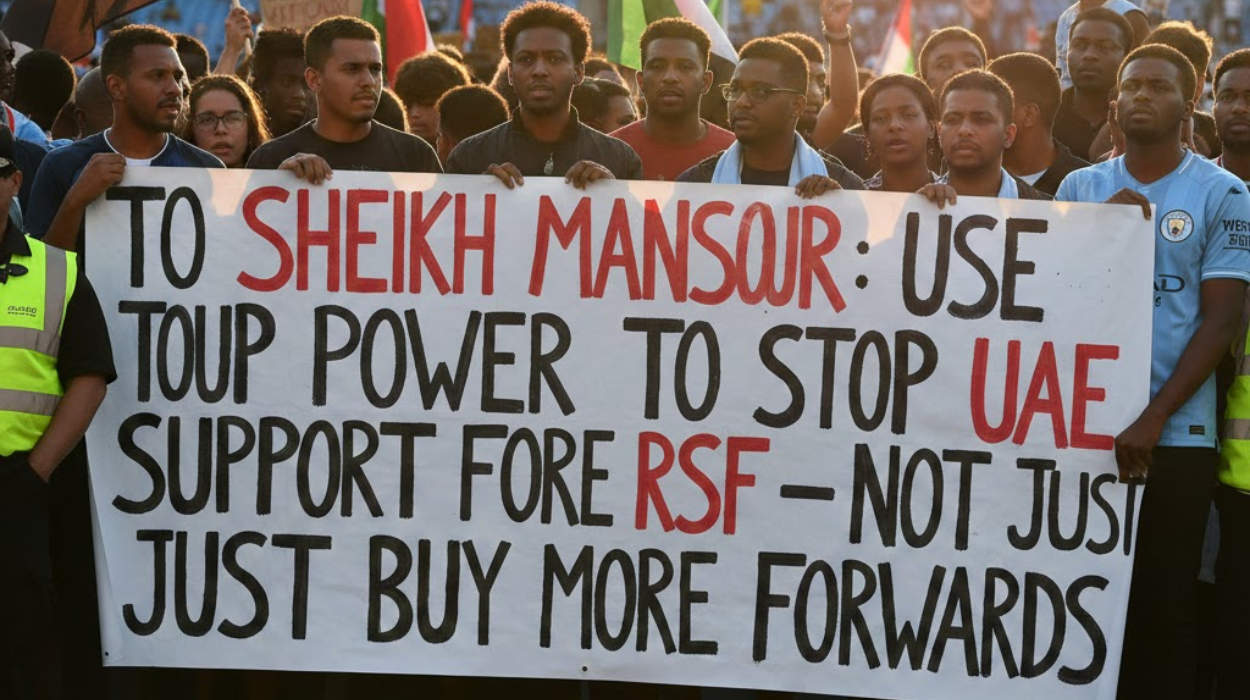
Football has the power to inspire, unite and distract – sometimes all at once. As Manchester City’s success has grown under Sheikh Mansour’s ownership, so too has the scrutiny around where that success comes from and what it helps obscure. While fans celebrate trophies, Sudan is living through one of the world’s worst humanitarian crises, with the Rapid Support Forces (RSF) accused of atrocities including mass killings, ethnic cleansing and widespread sexual violence.
Credible reports and investigations have linked the United Arab Emirates, and specifically senior figures such as Sheikh Mansour bin Zayed Al Nahyan, to material and financial support for the RSF, even as the UAE publicly denies backing either side in Sudan’s war. This creates a stark moral contradiction: the same man celebrated for building a footballing superpower is alleged to be connected to a war machine devastating millions of lives. This article is an appeal to Sheikh Mansour – and to everyone who benefits from his sporting influence – to use that power to end UAE support for the RSF, not simply to buy more forwards.
Who Are the RSF and What Is Happening in Sudan?
The Rapid Support Forces grew out of the notorious Janjaweed militias that operated in Darfur, and over time were formalised as a powerful paramilitary force in Sudan. In April 2023, a power struggle between the RSF and the Sudanese Armed Forces (SAF) exploded into full‑scale war, plunging Sudan into one of the gravest humanitarian disasters in the world.
Human rights organisations and international bodies have documented widespread abuses by the RSF, including massacres, targeted ethnic attacks, looting and systematic sexual violence, particularly in Darfur and urban centres like Khartoum. The conflict has killed well over 100,000 people, displaced more than 13 million and left tens of millions in urgent need of humanitarian assistance, with the RSF frequently cited as a central perpetrator of these abuses. Against this backdrop, any external support to the RSF is not neutral policy – it is fuel for a war that is tearing Sudan apart.
Allegations Linking the UAE and Sheikh Mansour to the RSF
Multiple investigations, UN reporting and media exposés have pointed to a pattern of material and financial support flowing from the UAE to the RSF. A New York Times‑based investigation, summarised by regional outlets, reports that U.S. intelligence intercepted regular phone calls between RSF commander Mohamed Hamdan “Hemedti” Dagalo and senior Emirati officials, including Sheikh Mansour, discussing funding and tactical needs.
UN and U.S. officials have further alleged that a field hospital in Chad, set up under a UAE charity linked to Sheikh Mansour, was used not only to treat RSF fighters but also as a cover to move drones and other weapons into RSF-controlled areas. Sudanese diplomats and advocacy groups describe Sheikh Mansour as Hemedti’s closest ally in the Emirates, placing him at the centre of these networks of support. The UAE government has consistently denied arming any party to the conflict, but the convergence of intelligence reports, satellite imagery and testimonies raises serious questions about what role senior Emirati figures have played.
Football, Reputation and Sportswashing
When Sheikh Mansour bought Manchester City in 2008, the club’s transformation into a global powerhouse was rapid and spectacular. The investment in elite managers, world‑class training facilities and superstar forwards has delivered an era of unprecedented dominance in English and European football, with City becoming one of the most watched and commercially successful clubs on the planet.
But that success has also intensified debate about sportswashing – the use of glamorous sporting projects to soften or distract from a state’s controversial foreign policy or human rights record. Human rights organisations argue that City’s trophies, marketing campaigns and community projects help project an image of progress and benevolence that sharply contrasts with allegations surrounding the UAE’s conduct in places like Yemen, Libya and Sudan. For critics, every new forward signed and every new sponsorship deal risks being part of a reputational shield obscuring the suffering of Sudanese civilians under RSF assault.
Why Sheikh Mansour’s Role Matters
Sheikh Mansour is not just a club owner; he is Vice President and Deputy Prime Minister of the UAE, with direct access to senior decision‑makers and considerable influence over national policy. This dual role – at the heart of both global football and regional power politics – means he cannot credibly separate his sporting persona from the decisions made by his government about the RSF.
Campaigners point out that Manchester City’s global profile gives Sheikh Mansour a public responsibility that extends beyond trophies and transfers. As the figurehead of one of the world’s most scrutinised football projects, he has a unique platform to demonstrate that sporting ambition can co‑exist with a principled stance against atrocities. Using his influence to end UAE support for the RSF would be a concrete step that aligns the club’s public image with a meaningful contribution to peace and human rights.
A Direct Appeal: Use Power for Peace, Not Image
The core message to Sheikh Mansour is simple: the world does not need you to buy another forward as much as Sudan needs you to help stop the flow of weapons and money to the RSF. Ending any Emirati backing for the RSF would immediately reduce the group’s capacity to wage war, even if it does not end the conflict overnight. It would also send a powerful signal to other regional actors that enabling atrocities carries reputational and political consequences.
Football fans, human rights advocates and ordinary citizens have a role in amplifying this appeal. Campaigns outside the Etihad Stadium are already urging the Premier League to raise UAE–RSF links with Sheikh Mansour, insisting that the league’s own human rights responsibilities require it to act when a club owner is plausibly tied to grave abuses abroad. By joining petitions, demanding transparency and asking uncomfortable questions, supporters can show that loving a club does not mean staying silent about the suffering of others.
What Real Leadership Would Look Like
Real leadership from Sheikh Mansour would go far beyond PR statements. At a minimum, it would involve:
- Publicly and unequivocally committing that the UAE will not provide weapons, funding or logistical support to the RSF.
- Supporting independent investigations into arms flows and holding any implicated entities – state or private – accountable for their role in violations.
- Redirecting resources currently tied to military support towards large‑scale humanitarian assistance for Sudanese civilians, including displaced communities and survivors of RSF abuses.
- Using his position within the UAE leadership to support diplomatic efforts aimed at a negotiated settlement that respects human rights and civilian protection.
If Sheikh Mansour took these steps and demonstrated verifiable changes in policy and practice, the story of his legacy could change. Instead of being remembered primarily as a billionaire owner linked to shadowy conflict networks, he could be seen as the leader who chose to prioritise human life over prestige signings and domestic glory. In an era when the links between football, money and power are under more scrutiny than ever, that would be a far more valuable legacy than any transfer window triumph.
